ORF: Onboard Radiometric Fingerprinting System
June 15, 2023


Photo by Benjamin Suter at Unsplash
Photo by Austrian National Library at Unsplash
Photo by Karsten Würth at Unsplash





Effects of Hardware Imperfections
- IQ modulation: combination of two baseband signals \(I(t)\) and \(Q(t)\)

- carrier frequency offset \(CFO = f_{rx} - f_{tx}\)
- also mismatch in phase and (sampling) time
- IQ plot: 2D-representation of \(I(t)\) and \(Q(t)\)
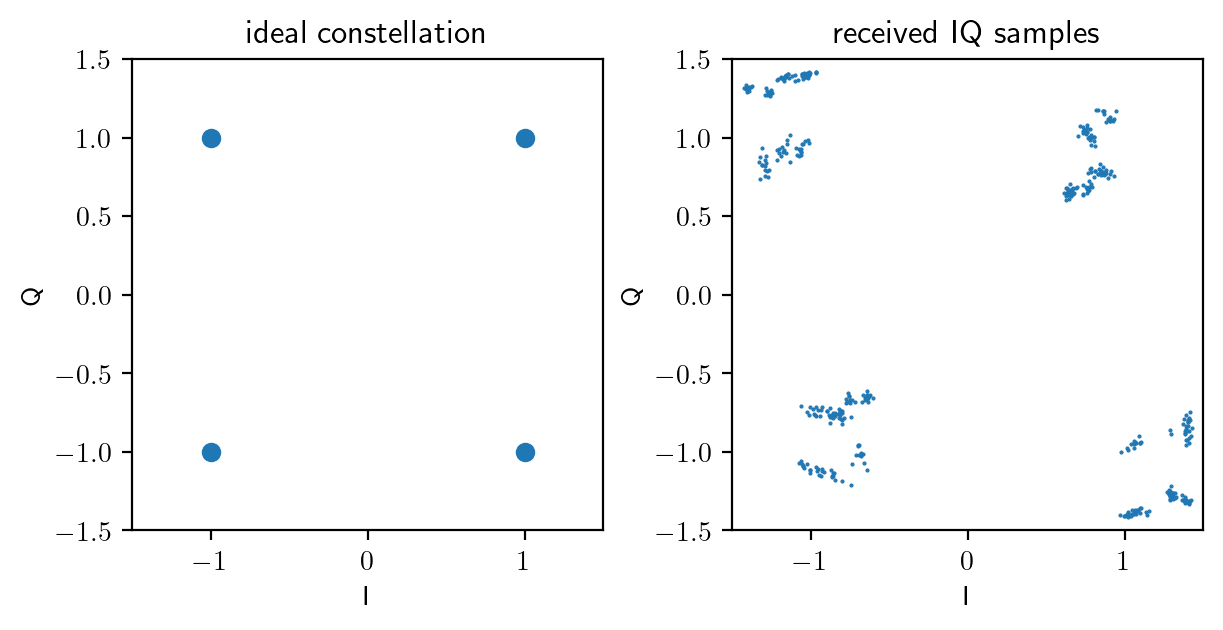
- distortions in constellation diagram
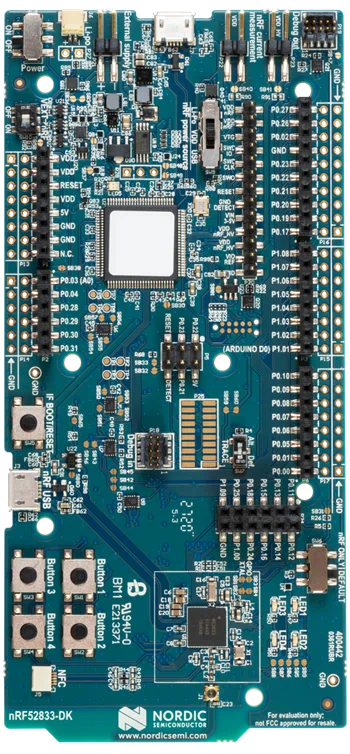
Platform: nRF52833 SoC
- 64 MHz Arm Cortex-M4 with FPU
- 512 KB ROM, 128 KB RAM
- PHY protocols:
- BLE with Bluetooth Direction Finding
- 802.15.4-2006
Stage 1: IQ Sampling

Onboard IQ Sampling
- available thanks to BLE DFE

BLE DFE
- two modes:
- Angle of Arrival (AoA)
- Angle of Departure (AoD)
- direction estimation over CTE (max \(160 \mu s\))
- sampling during reference period (1 MHz) and once per sample slot (500/250 kHz)

Challenges for ORF
- IQ sampling at single antenna:
AoD
- high IQ sampling rate: up to 8MHz
- IQ sampling over whole frame: after
ADDRESSevent
- long IQ sampling duration: up to \(504 \mu s\)
- continuous IQ sampling: investigated for 802.15.4

Stage 2: Feature Extraction

ORF Features
- synchronization-based and constellation-based
- typical coherent-receiver pipeline following [1]
- challenges: device constraints, limited amount of IQ samples
- Carrier Frequency Offset (CFO)
- Rice, Michael. Digital Communications - A Discrete-Time Approach. 1st ed. New York, NY: Prentice Hall, 2008.


Constellation-based Features
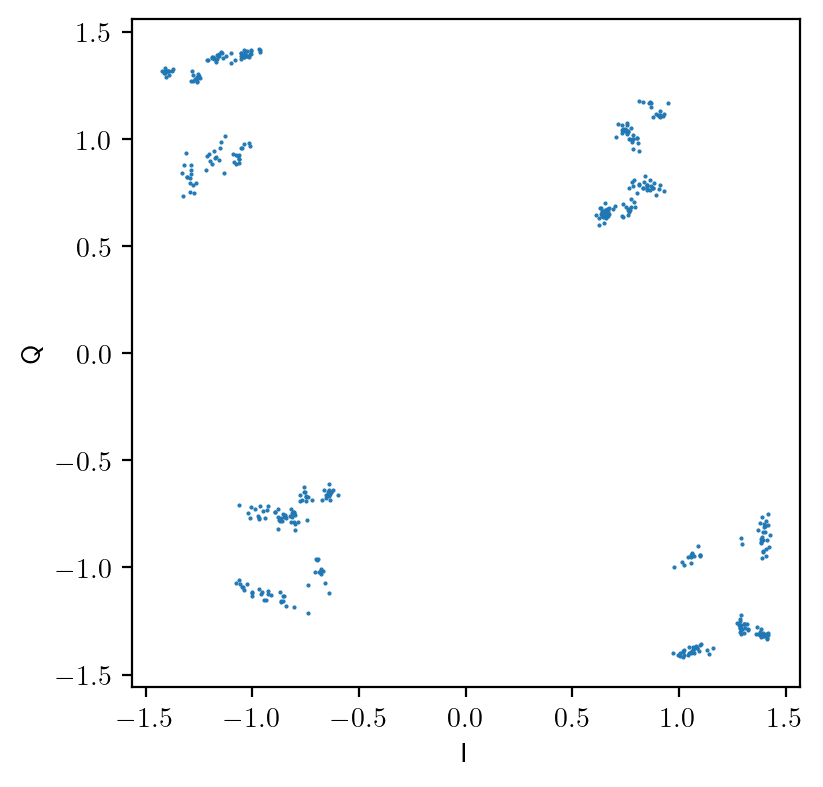
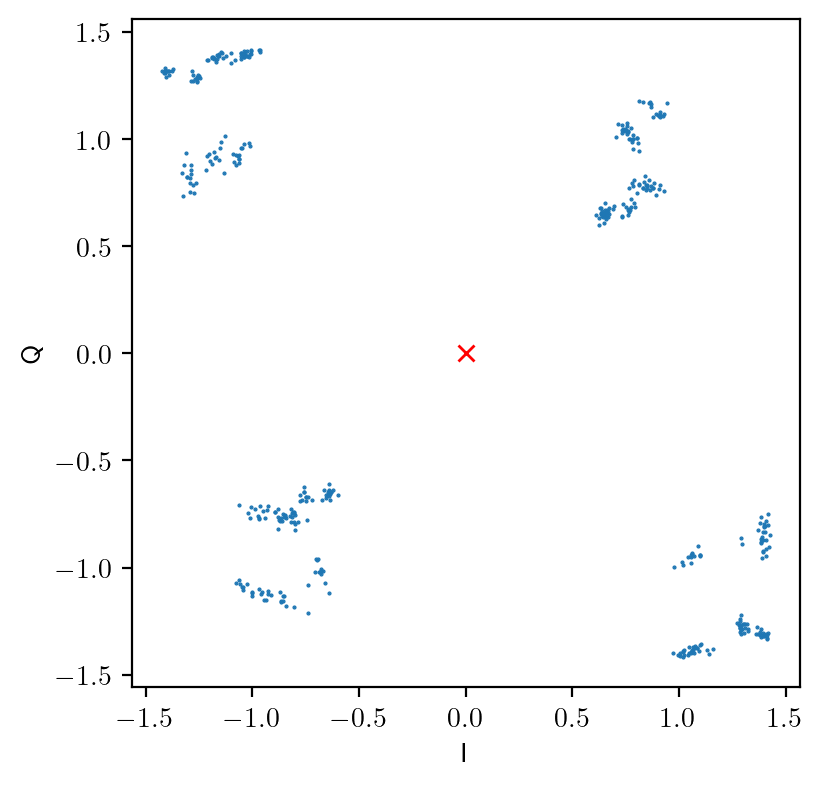
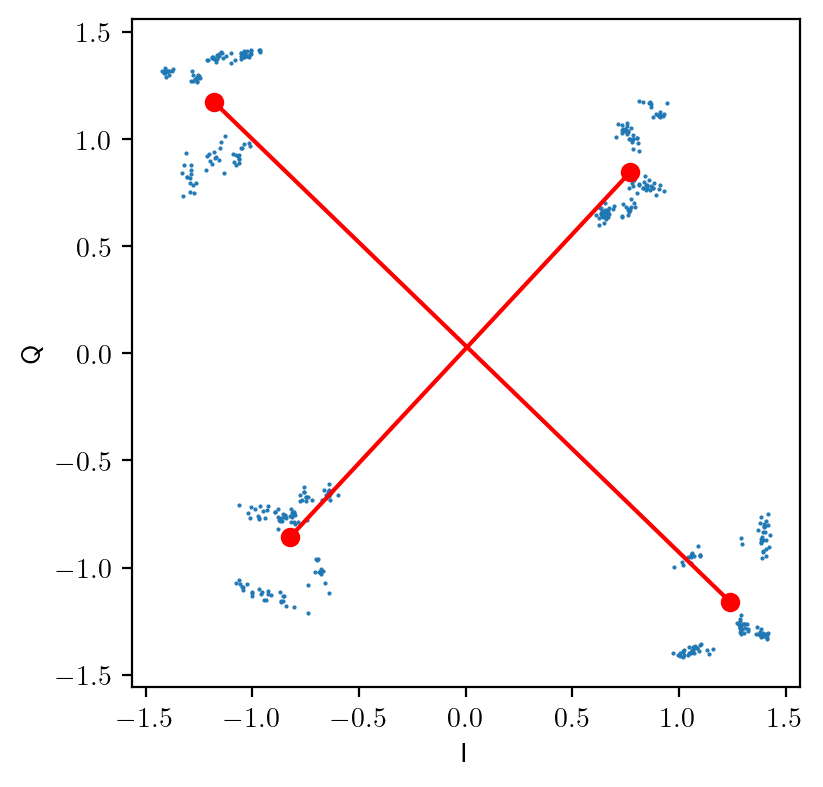
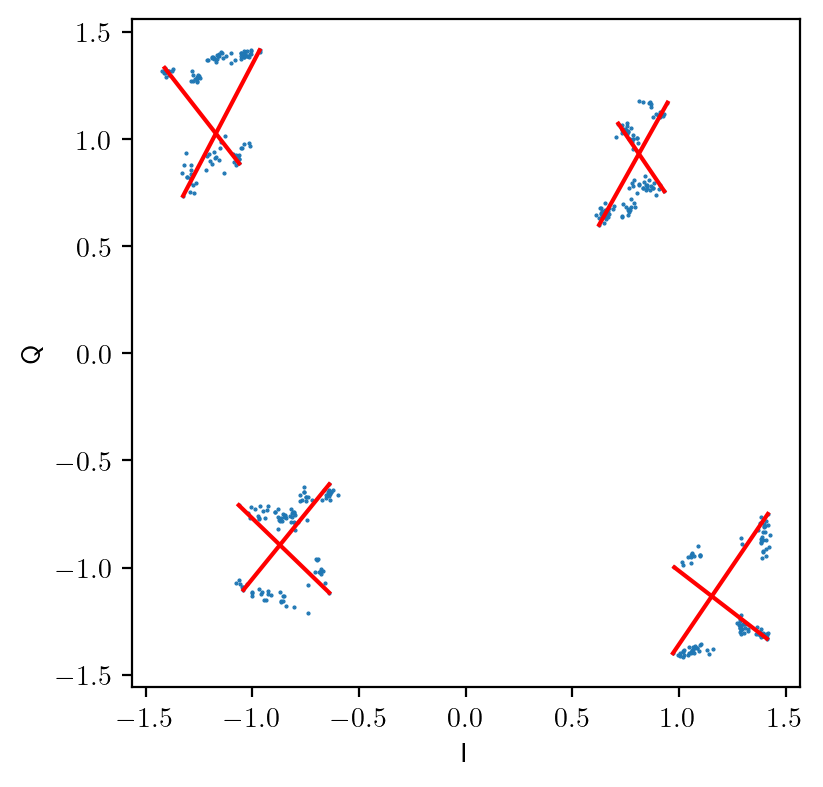
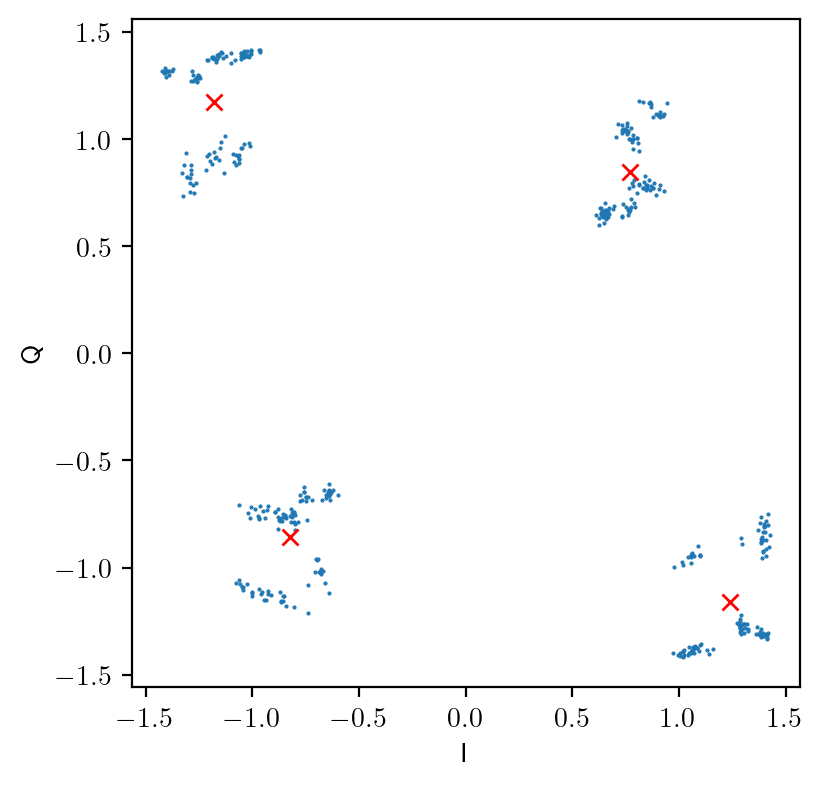
- IQ Offset (IQO)
- IQ Skew (IQS)
- Constellation Cloud Shape (CCS)
- Error Vector Magnitude (EVM)

Stage 3: Fingerprint Classifier

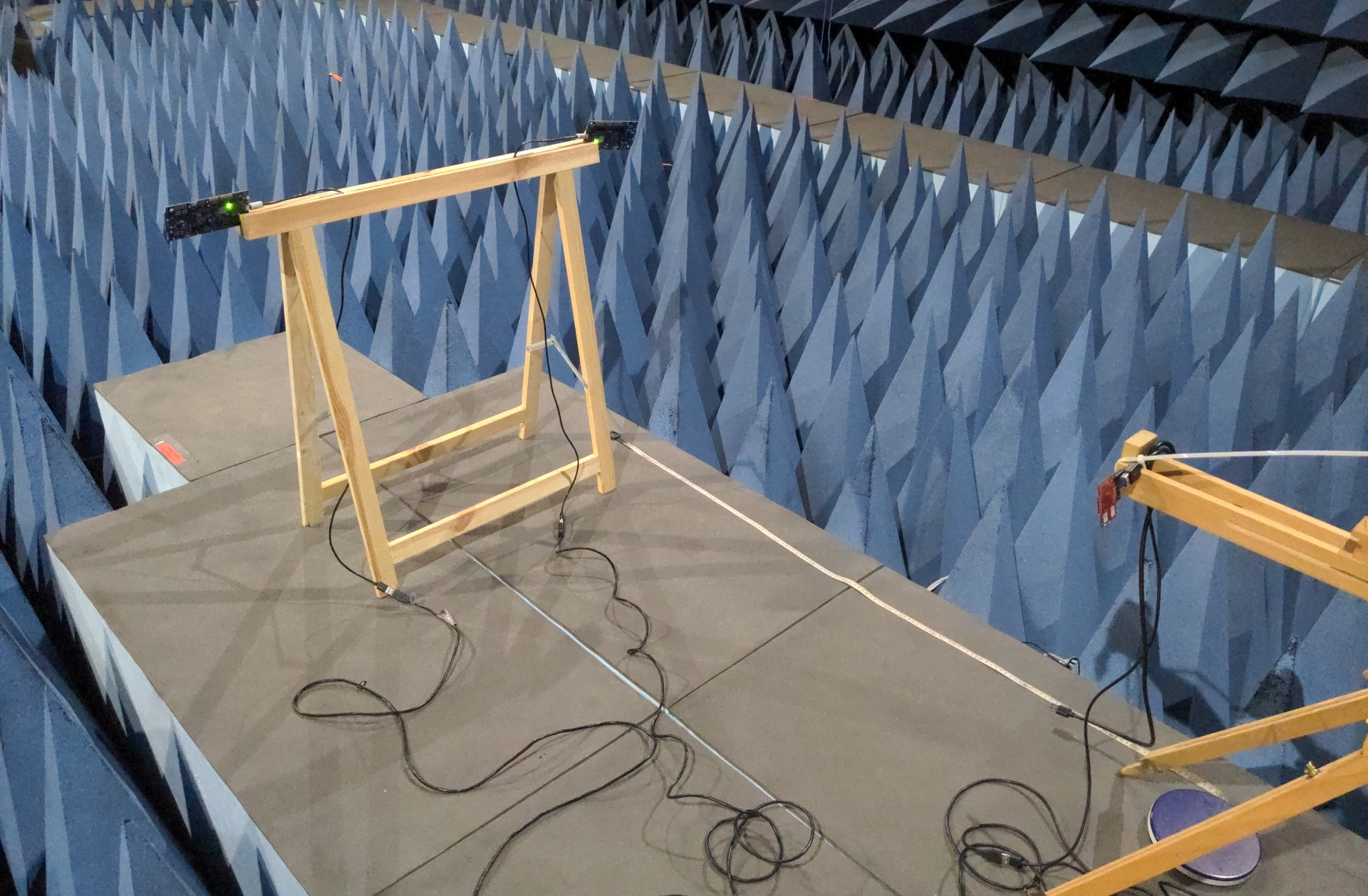
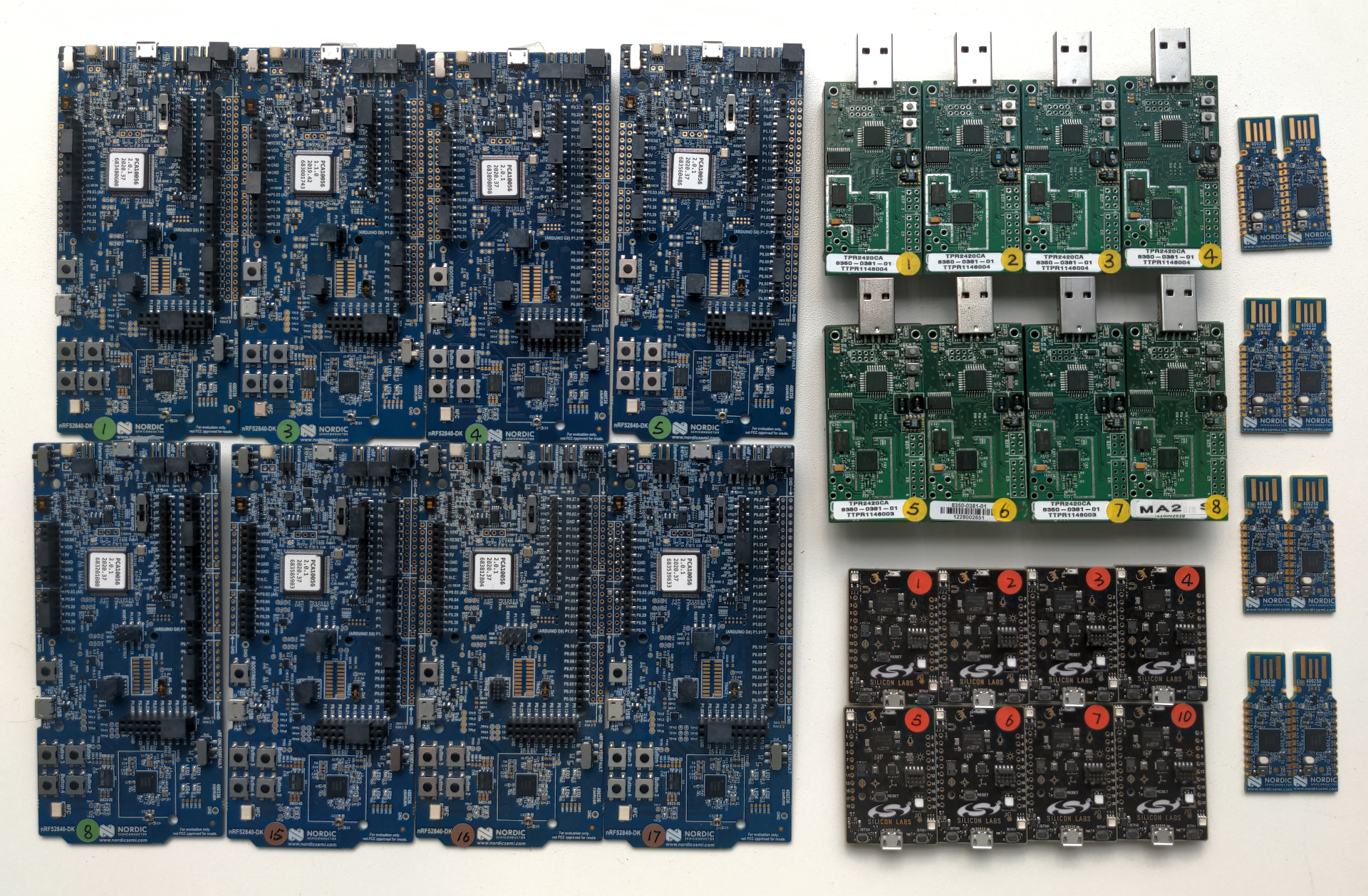
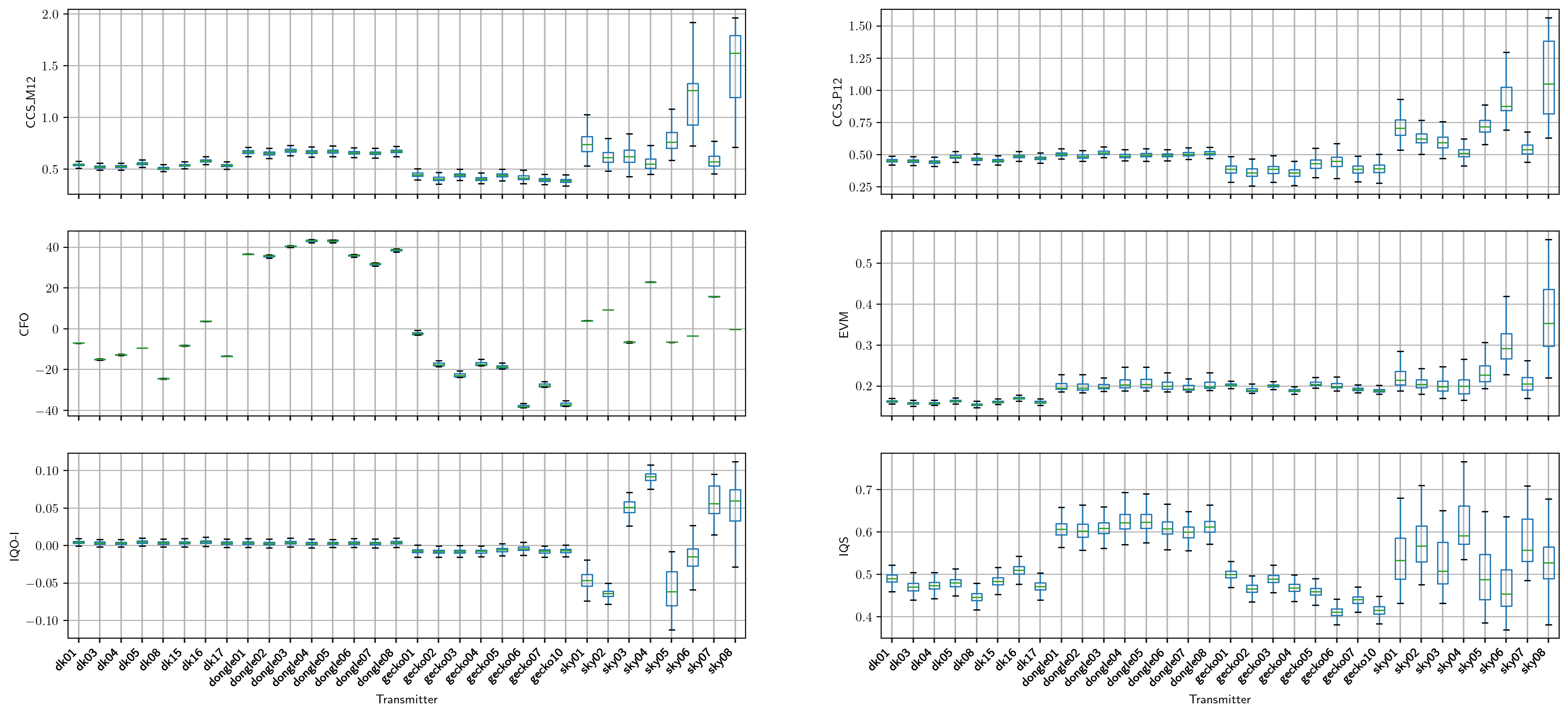
Feature Quality
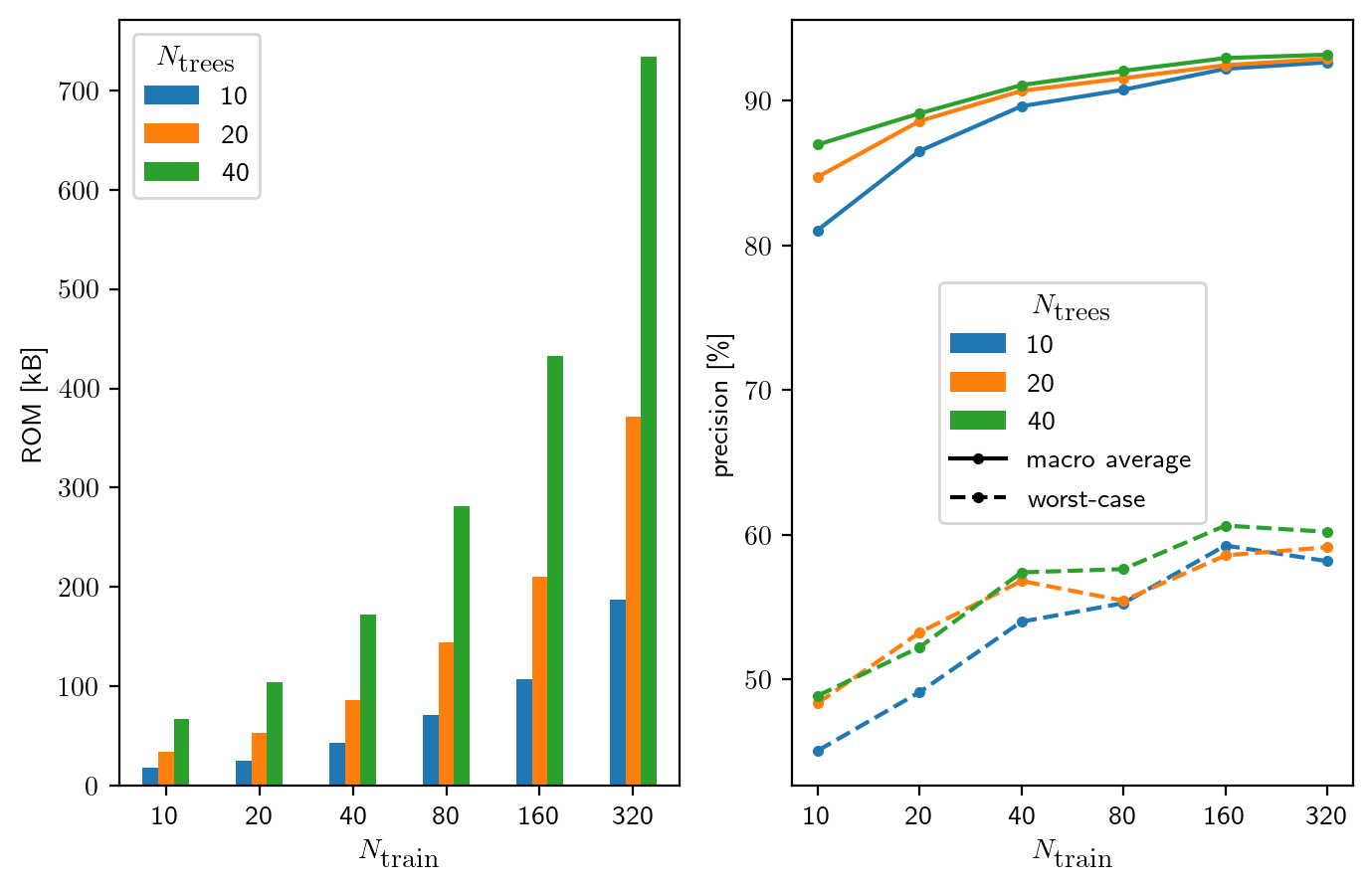
Classification Performance
- memory/performance tradeoff
- considered hyperparameters: \(N_\textrm{trees}, N_\textrm{train}\)
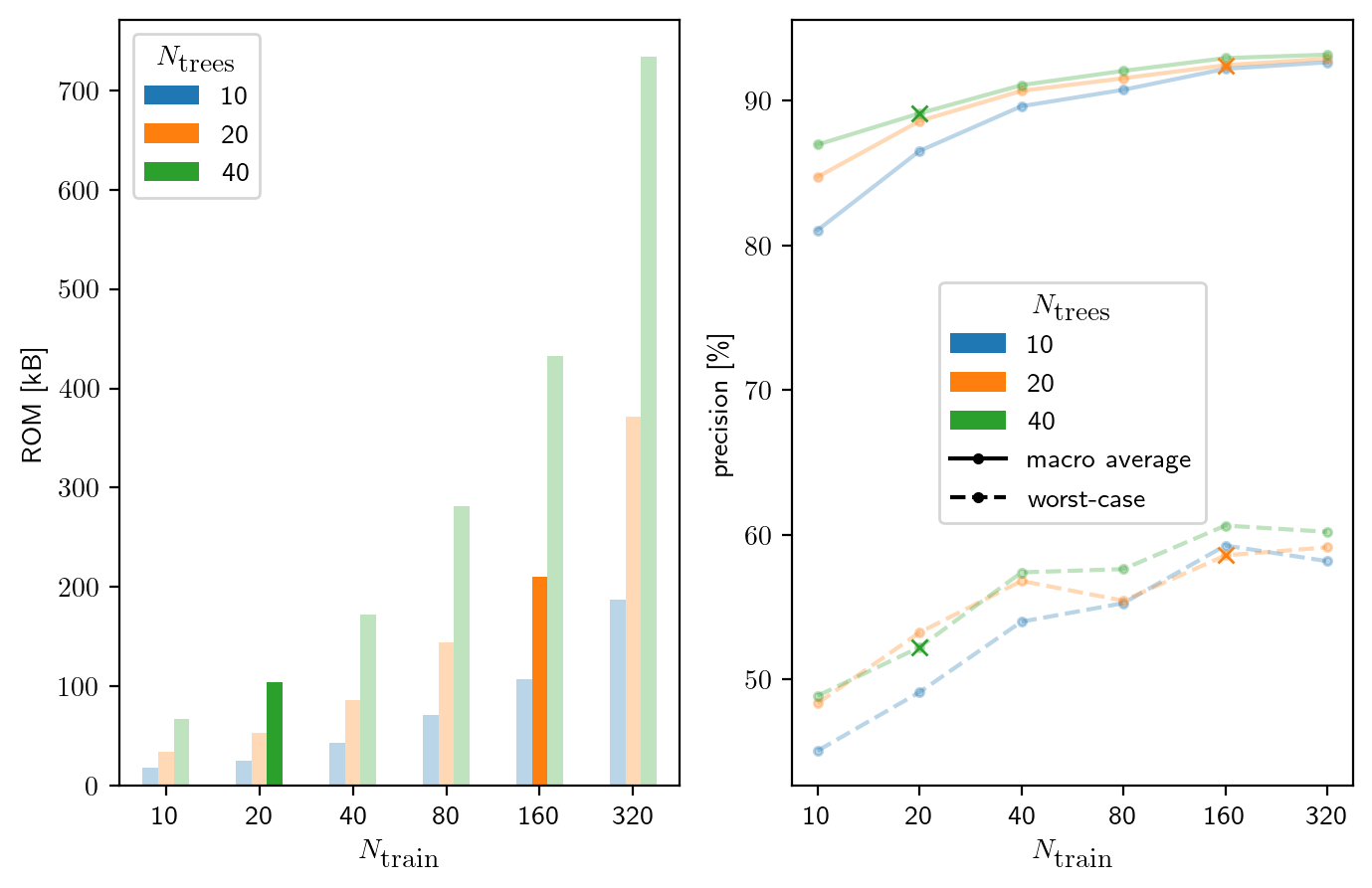
\(N_\textrm{trees} = 40, N_\textrm{train} = 20\)
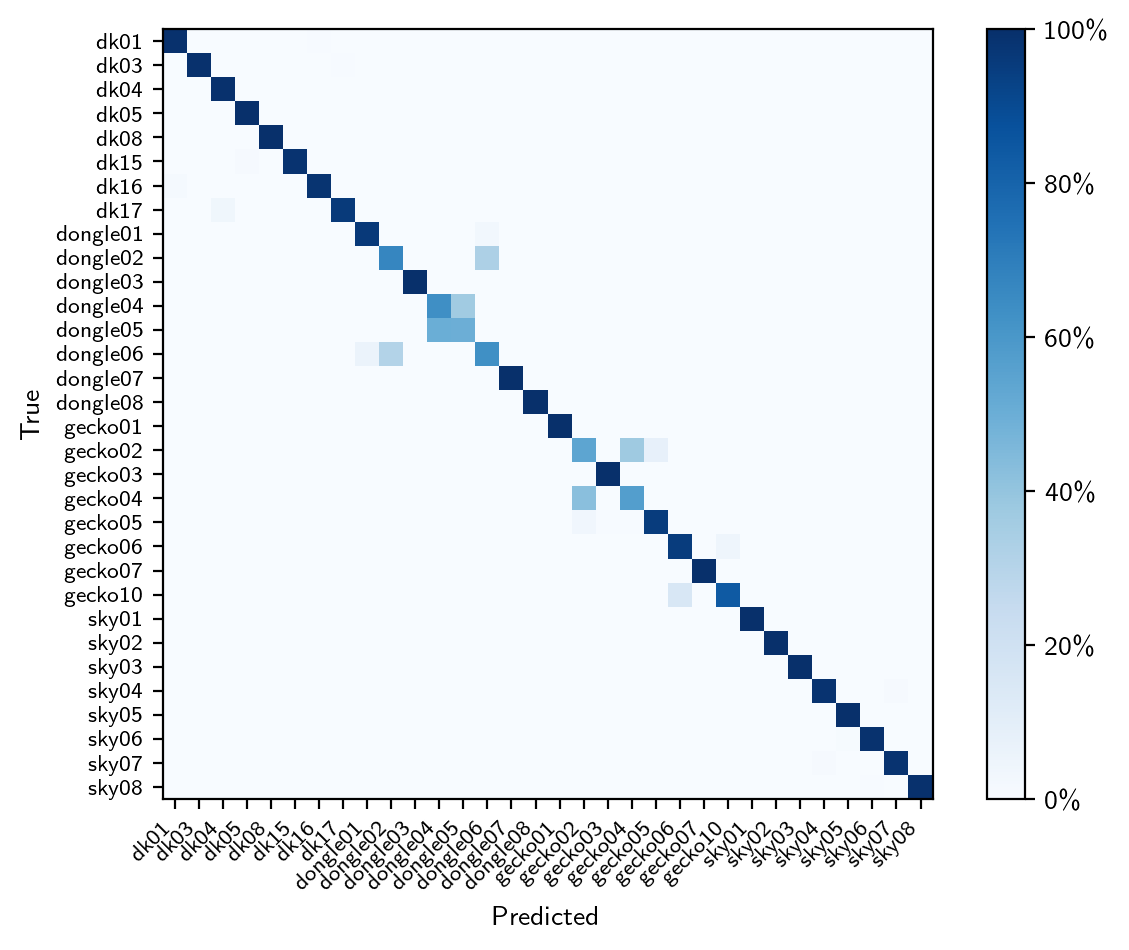
| precisionmacro | 90.9244 |
| recallmacro | 90.9392 |
| accuracy | 90.9499 |
| precisionwc | 53.5789 |
| recallwc | 49.7886 |
\(N_\textrm{trees} = 20, N_\textrm{train} = 160\)
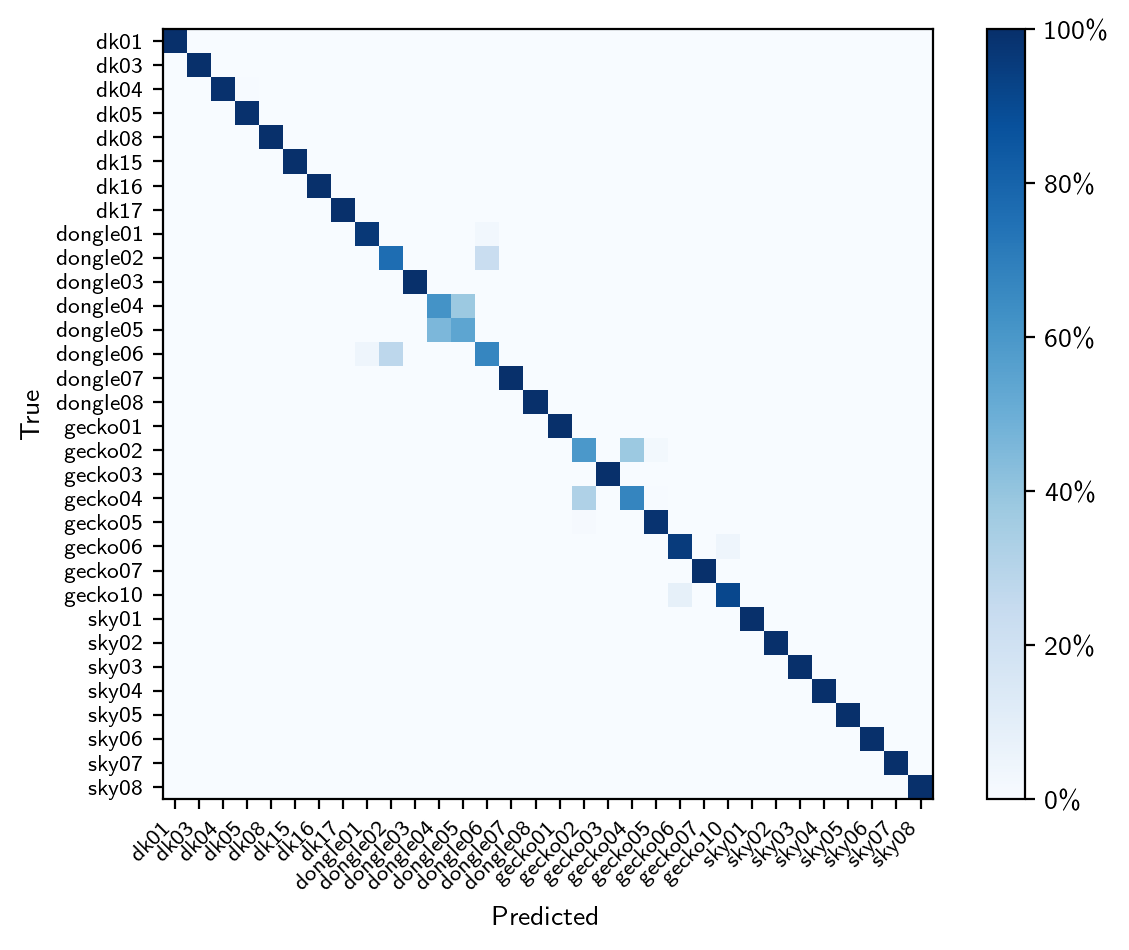
| precisionmacro | 92.6734 |
| recallmacro | 92.6893 |
| accuracy | 92.7005 |
| precisionwc | 57.6835 |
| recallwc | 54.2184 |
\(N_\textrm{trees} = 20, N_\textrm{train} = 160\), reduced dataset
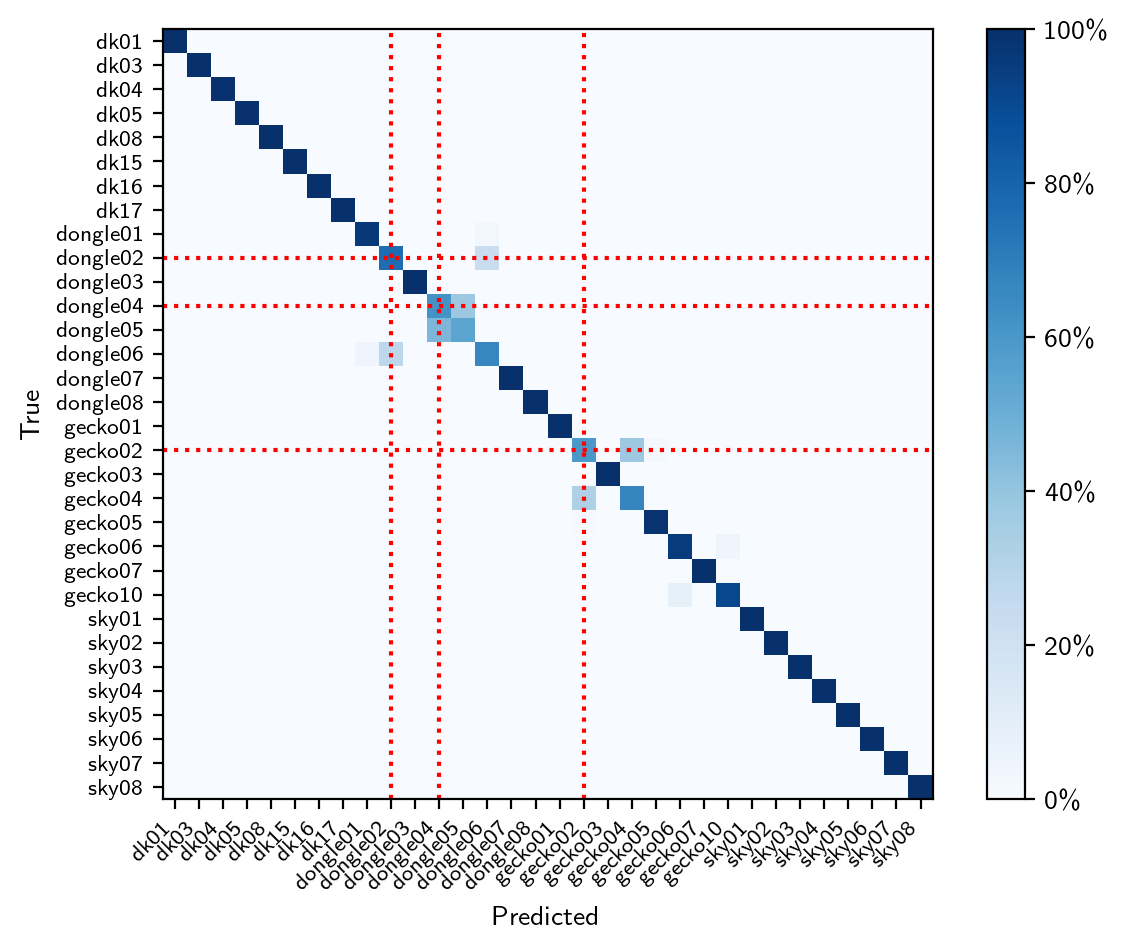
| precisionmacro | 99.0599 |
| recallmacro | 99.0564 |
| accuracy | 99.0567 |
| precisionwc | 92.7294 |
| recallwc | 92.4411 |
Resource Consumption